
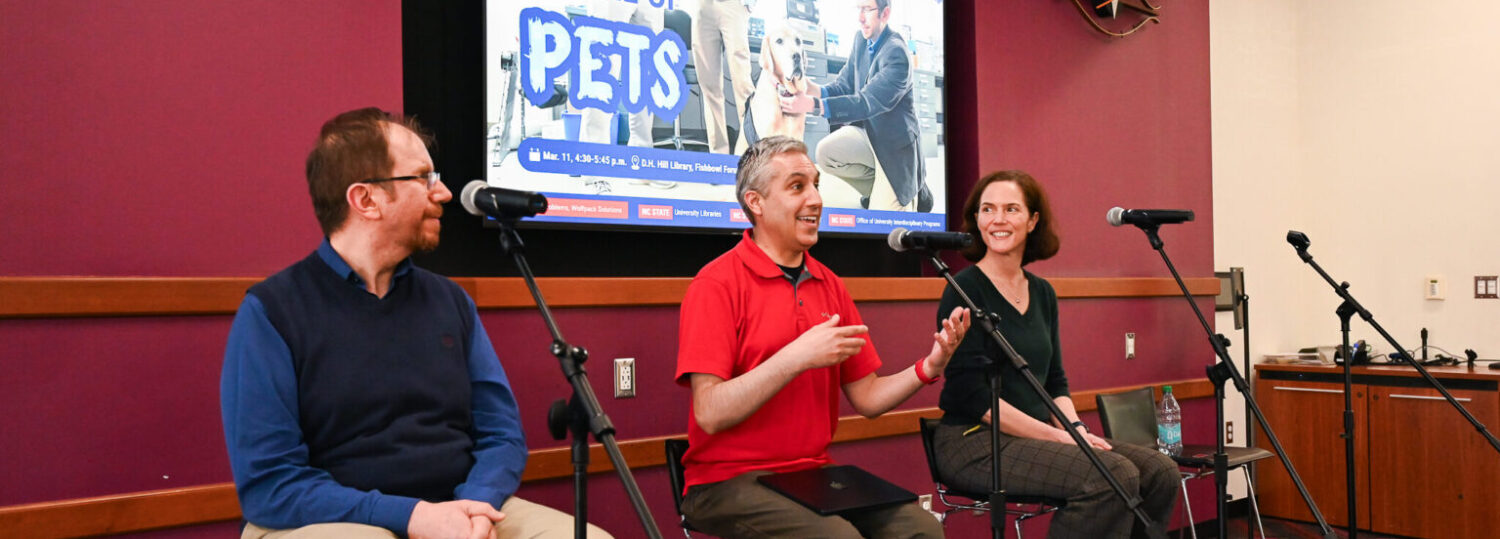
On March 11, students, faculty, and staff gathered in the Fishbowl Forum for the Hopeful Futures: Future of Pets event to discuss human relationships with pets and how AI and genetic tools are advancing research on our furry friends. The “Hopeful Futures” series is part of the Long View Project and is co-sponsored by the Libraries, the Office of University Interdisciplinary Programs, the Global One Health Academy and Wicked Problems, Wolfpack Solutions.
Kristen Fontana 6-min. read
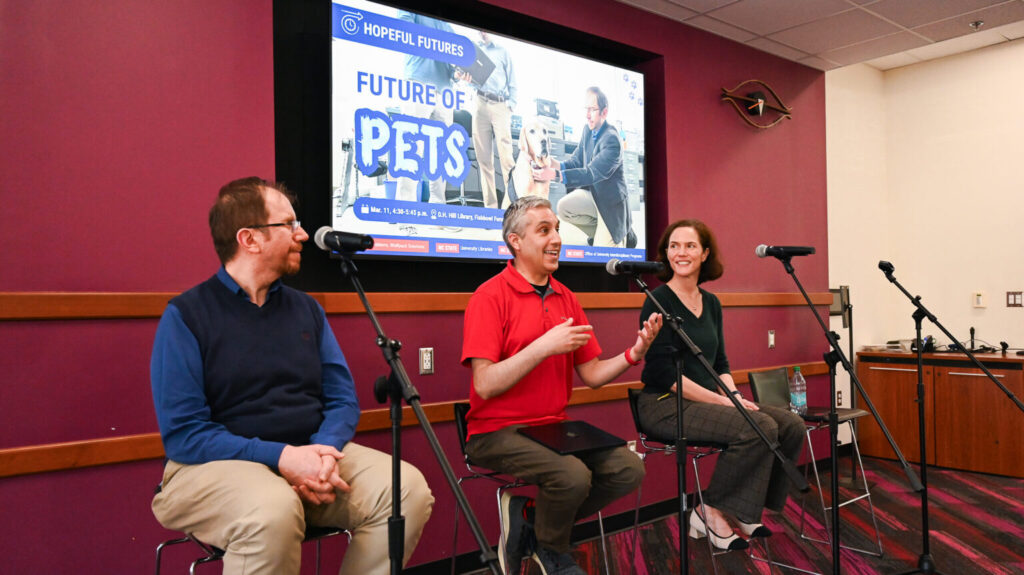
Left to right: Panelists Alper Bozkurt, Carlos Goller, and Margaret Gruen address the audience during the Hopeful Futures: Future of Pets event.
Did you know that over 70% of households in the U.S. have pets? Pet ownership has been steadily increasing over the last 35 years, up from 56% in 1988. As pets continue to make up an increasingly important part of our everyday lives, we can’t help but wonder what the future holds. Will current genetic testing and cloning technology advance to prolong our furry friends’ lives or even bring them back after they’re gone? Will we be able to directly communicate with them with the help of AI? During last week’s Future of Pets event, Alper Bozkurt (COE), Carlos Goller (COS), and Margaret Gruen (CVM) teamed up to help answer these, and other, questions!
Shared Genes
The event, moderated by GOHA’s very own Meredith Spence Beaulieu, kicked off with the topic of genetics, specifically on dog genetic testing companies. As the number of pet-owning households increases, so does the desire for owners to know more about their pet, such as their breed and likelihood of disease. But before you purchase veterinary DNA testing, you may want to first learn about the validity of these tests. Gruen expresses that dog DNA tests unfortunately are not very accurate in identifying breed or predicting disease. To test the accuracy of dog genetic testing companies, Marketplace submitted the DNA of two mixed breed dogs, a purebred, and one human to four different companies. The results were… interesting. Not only was a purebred Great Dane classified as a chihuahua, but the human’s DNA apparently proved that he was a descendent of a purebred beagle! And just to clarify, human DNA tested for dog DNA should result in an error, not a dog breed (yet 50% of the tested companies claimed dog lineage on the human DNA). Over time and with improved technology we should see better results, but for now, you may want to reconsider genetic testing and perhaps put those dollars toward a new treat or toy instead!
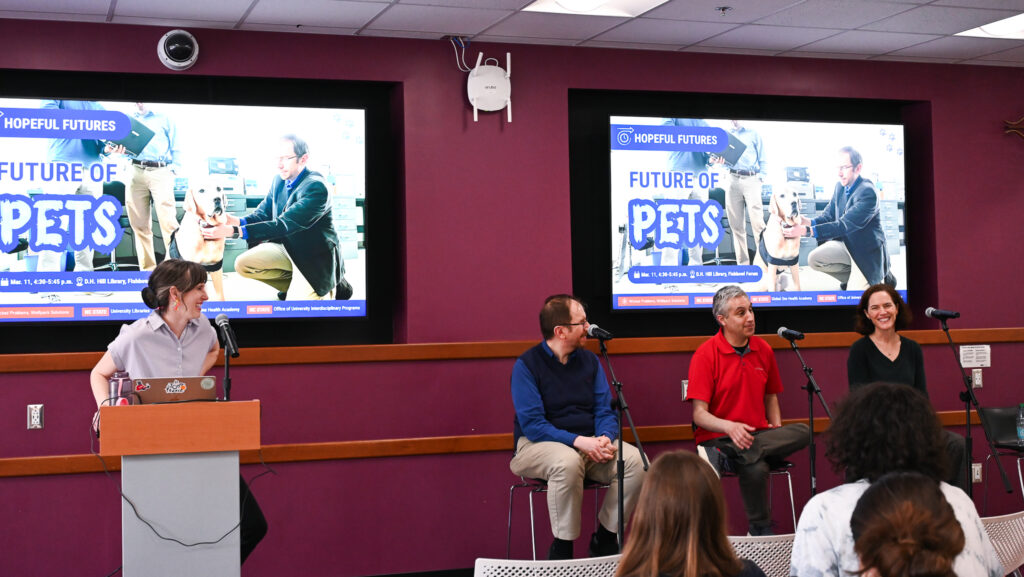
Left to right: GOHA Program Manager Meredith Spence Beaulieu leads a panel discussion with Alper Bozkurt, Carlos Goller, and Margaret Gruen, during the Hopeful Futures: Future of Pets event.
While our DNA should not test positive for any dog breed, humans do share a significant portion of their genes with dogs, which can be beneficial when researching human health. Goller, who studies metagenomics, explains that mice are often used in experiments for human health, but these organisms do not have much in common with humans. They are in a controlled environment and not exposed to the same stimulants and stressors as humans. Oftentimes, scientists have to replicate external conditions and diseases, such as cancer, in mice for the purposes of human health research. Rather than artificially replicating human conditions, scientists can instead turn to our canine friends. In addition to sharing 84% of genes with humans, dogs naturally get many of the same diseases as humans, such as certain types of cancer, and are already exposed to similar environments as humans, thus making them a great candidate for human health research.
Seeing Double
Continuing on the topic of genes, the discussion shifted to cloning, which has become increasingly popular amongst celebrities, such as Tom Brady and Barbara Streisand who have cloned their pet dogs. Gruen explains that while you can effectively clone your furry friend’s genes, that does not mean the animal will have the same personality. This comes down to the nature versus nurture debate. The personality of your furry friend is not entirely driven by genes (nature), but is also shaped by other external factors (nurture). In addition to having a different personality, there is no guarantee that your cloned pet will look exactly the same either. Despite having the same DNA, the cloned pet does not experience the same environmental womb factors that can determine gene activation and ultimately shape coat color or patterns. Part of what makes your beloved companion animal so special is not just their genetic makeup but also their shared experiences with you – which no form of cloning could ever fully replicate.
Understanding our Furry Friends
Will AI allow us to really communicate with our beloved companion animals? Could Dug, the talking dog from the movie Up (2008), become a reality? While that would be amazing (or perhaps unsettling for some), such technology does not yet exist. However, Bozkurt credits this movie as inspiration for the creation of his own smart dog collar capable of tracking and interpreting data on dog activity levels and external conditions. The collar was developed to aid in the early phases of guide dog training. Data is tracked and transmitted in real-time to an artificial intelligence system where it is analyzed to help identify qualities best suited for guide dogs. The collar is capable of capturing data on activity levels, barking, light, temperature, and sounds. AI is helping researchers like Bozkurt to better understand our pets and their various behavioral states, which aids in our inter-species communications. Thanks to AI (and Up), Bozkurt’s smart collars are already having a positive impact on the vision impaired. Guiding Eyes for the Blind, a nonprofit organization that provides service dogs to those with vision impairment and other disabilities, has utilized these collars to help with early monitoring and prediction of suitability of potential service dogs, saving both time and money.
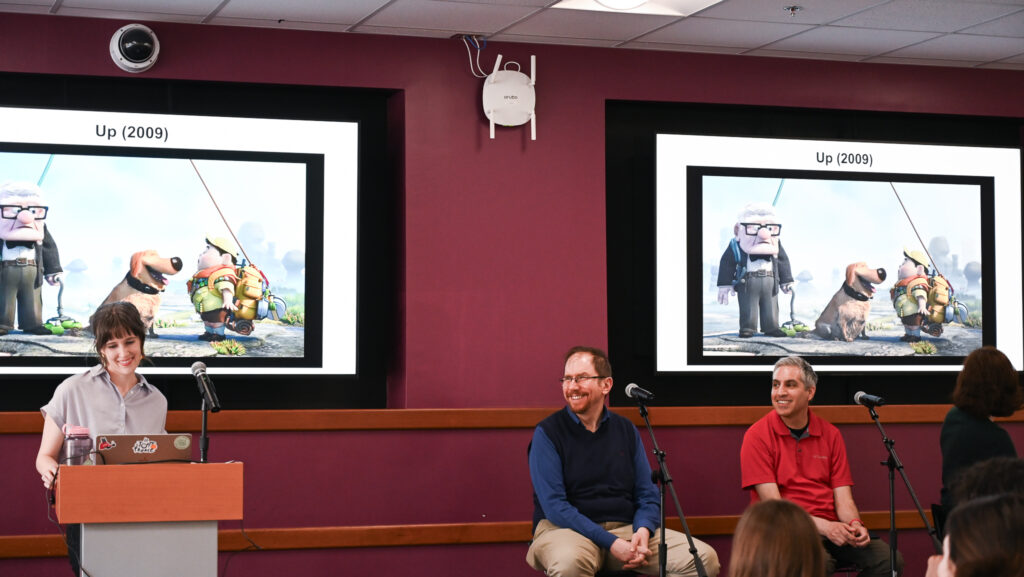
A clip from Up (2008) showing Dug’s talking dog collar is shared with the audience during the Future of Pets event.
Robotic Cockroaches?
Not only has Bozkurt gotten inspiration from a fictional movie, but he has also served as an official consultant for another fictional film: G-Force (2009), a movie about a team of specially trained guinea pigs on a mission to stop a ruthless billionaire from taking over the world. As founder and Director of the Integrated Bionic MicroSystems (iBionicS) Laboratory at NC State, Bozkurt has a lot of experience with novel bionic interfaces, including in cockroaches, plants, mussels, canines, and even humans. Bozkurt’s expertise proved vital in crafting scenes with robotic insects, such as one with a cockroach equipped with a camera breaking into a secured area to retrieve a microchip. Bozkurt’s research proves that such a heist is actually possible – almost! While unable to physically retrieve an item, cockroaches can be remote controlled to traverse a specified path thanks to Bozkurt’s innovative research. Through wires that attach to the roach’s antennae and cerci (sensory organs on the abdomen), the cockroach is stimulated via pulses to travel in a specified direction. This type of technology could be useful in search and rescue operations, where insects can fit into spaces that other animals, people, or devices could not.
Are Raccoons the Next Pet?
To date, humans have domesticated 41 species of animals, with most being mammals. Does this mean that we could train and domesticate insects in the same way we can with larger animals? Bozkurt shares, “Not to the same degree.” So don’t expect your pet cockroach to be able to do flips or act on command (unless you have access to one of Bozkurt’s electronic interfaces). But animal domestication is still occurring, and is being shaped by our increasingly urbanized world. For example, early signs of self-domestication in raccoons have been noted, evident by phenotypic changes such as shorter snouts. Such changes were found specifically amongst raccoons living in urban areas in close proximity to humans. In order to adapt and survive in a human based environment, these animals have to not only be bold, but also tolerant. Over time, this imposes a selection pressure that favors tameness, further instilling these behavioral qualities and accentuating certain “cute” physical features over time and generations. Despite these early signs of domestication, this does not mean that you can have a pet raccoon. They are still wild animals.
The Future of Pets
We have seen how humans are shaping the future of pets, but how are pets shaping the future of humans? Pets are having a significant impact on the decisions humans make, such as where to live and even the job positions they take. We are also witnessing a decline in fertility rates, with people preferring to have pets over children potentially playing a role. In addition to the shift in lifestyles, pets offer some positive health benefits to us owners as well! Along with the well known mental health benefits, our furry friends also can benefit our physical health through the microbes they carry. Exposure to our pets’ microbes can help diversify our microbiomes, thus strengthening our immune system and lowering the risk of certain conditions, like allergies and asthma.
When asked what excites them most about the future of pets, the panelists all shared that they are looking forward to the future contribution of pets for both companionship and research, specifically in regard to how our shared environment can offer unique insight and opportunities. Animals have become beloved companions and integral parts of our home life, and advances in science and technology offer a hopeful future for pets and our human-animal relationships!
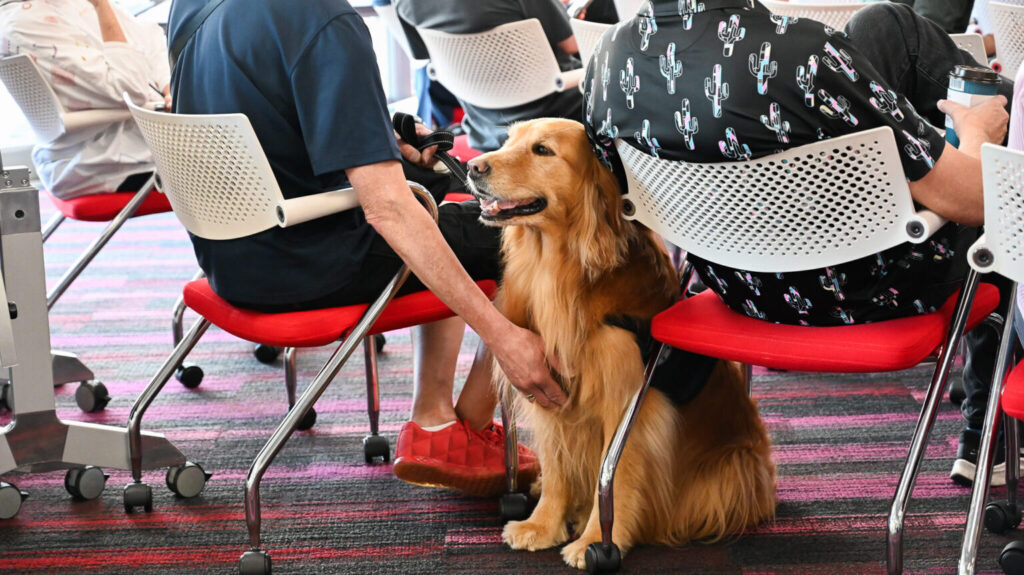
Pause for Paws service animal sits after greeting attendees before the event.