
Congratulations to NC State ECE Ph.D. student Yifan Wu on receiving the Best Presentation Award at the 2025 Animal-Computer Interaction International Conference (ACI). Mentored by Professors David Roberts (CS) and Alper Bozkurt (ECE, ASSIST and IConS), Wu presented his paper, “Toward Automated Pain Evaluation in Osteoarthritic Dogs Through Inertial Data and Machine Learning” last month at the conference in Indiana; this is his second time receiving this award.
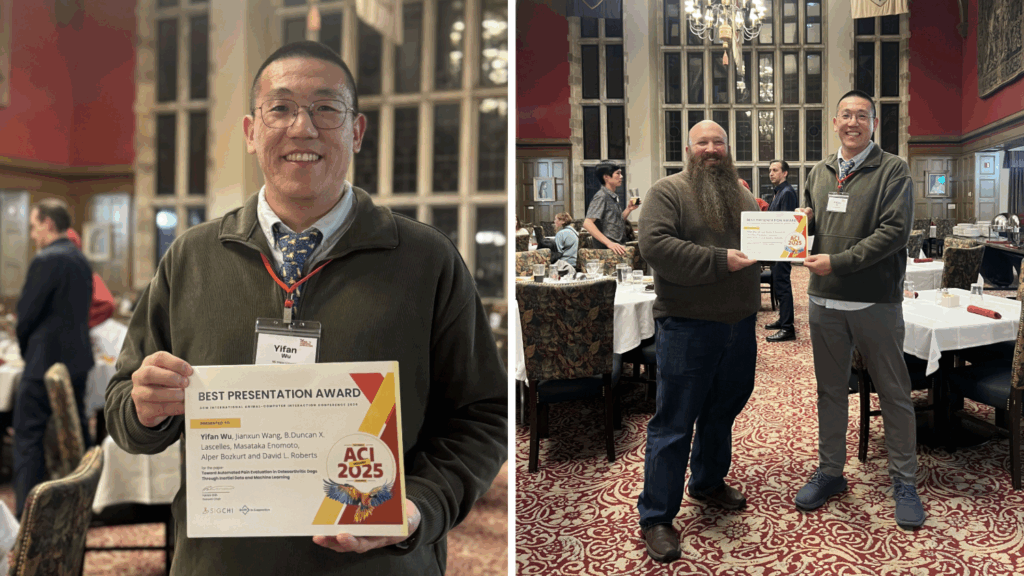
The ACI Conference brings together computer scientists, interaction designers, engineers, ethicists, veterinarians, biologists, zoologists and professionals from a variety of industries; the conference itself focuses on understanding interactions between animals and technology, designing technology for the well-being of animals and giving animals a “voice” rather than guessing what their behaviors mean to humans.
Wu, who studies electrical engineering, uses different sensing technologies and artificial intelligence methods to bridge the gap between dogs and computers. Wu, Roberts and Bozkurt work in collaboration with Professor Duncan Lascelles from the Translational Research in Pain Program and the Comparative Pain Research and Education Center, both part of NC State’s College of Veterinary Medicine (CVM). Using inertial data collected from osteoarthritic dogs by the CVM team, he applies machine learning approaches to help veterinary professionals identify pain associated with early onset osteoarthritis – a condition typically challenging for veterinarians to diagnose.
In addition, Wu, Roberts and Bozkurt work in collaboration with guide dog training facilities worldwide, where they research and develop novel sensing and AI technologies to objectively evaluate and identify potential guide dogs as early as 7 ½ weeks of age. The outcome of this research can provide training insights to guide dog professionals in making their selection and training processes more efficient and cost effective, enabling them to help more people in need of a guide or service dog.
Wu is passionate about using data to unearth meaningful insights that help in real-world decision-making situations. One of his future goals is to apply AI and data analytics to a broad range of impactful applications.
Note to Editors: The study abstract follows.
“Toward Automated Pain Evaluation in Osteoarthritic Dogs Through Inertial Data and Machine Learning”
Authors: Wu, Yifan, Jianxun Wang, B. Duncan X. Lascelles, Masataka Enomoto, Alper Bozkurt and David L. Roberts.
Published: Nov. 30, 2025, ACI ’25: Proceedings of the ACM 12th International Conference on Animal-Computer Interaction. Article No.: 6, Pages 1 – 13
Abstract: Osteoarthritis (OA) can cause great pain for dogs, limit their daily activities and negatively affect their quality of life. In most veterinary practices, evaluating pain caused by OA is done by veterinary professionals performing examinations and making subjective assessments. In this study, we proposed a novel objective approach using a wearable device equipped with an inertial measurement unit (IMU) to collect high-frequency movement data from dogs and to use machine learning methods to analyze pain status from 28 dogs. Using manifold learning, we were able to generate natural clusters between healthy dogs and those affected by OA pain. Using four simple supervised learning methods and manually extracted movement features as input, we achieved high performance using certain input data streams (100% precision for OA-pain affected dogs, 83% recall and 89% overall classification accuracy). Furthermore, using a custom neural network model, we achieved the best performance of 71% precision, 92% recall and 72% accuracy using raw IMU data as input. As a preliminary study, we also explored the use of a specific task data against using all the data from the entire session to compare the prediction performance. We also compared the prediction capabilities of different input data streams. Although preliminary, the results were promising and indicated that IMU data and machine learning methods could be further leveraged to achieve an owner-conducted early OA pain screening process in an at-home environment where dogs are most comfortable.